1Manual dual-track ops
The local site kept changing while provincial reports were patched by hand or ad-hoc scripts.

Government
A side-car sync hub that pushes increments by watermark without touching the original site; failures are searchable and resumable.
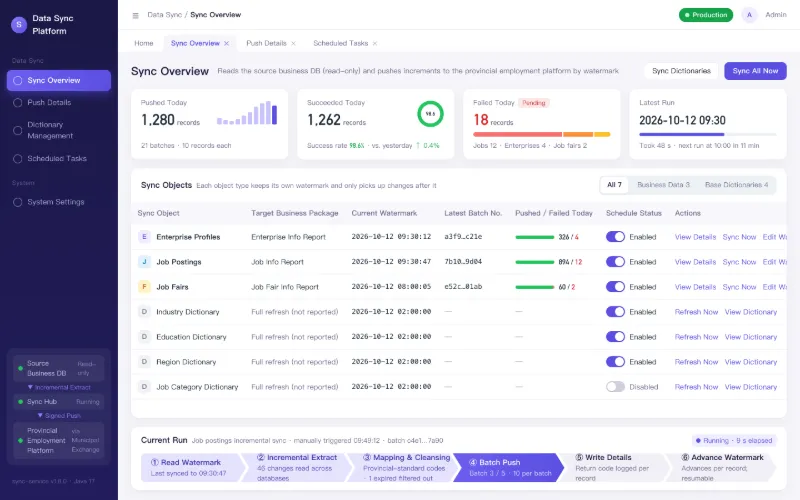
The client operates a city-level public HR marketplace whose employer onboarding, job postings and job-fair registration all run on a legacy PHP recruitment site. Provincial rules also require employer, job and job-fair data to be reported to Xiang Jiuye, Hunan’s provincial employment platform — until now done by hand or with one-off scripts, so the two datasets kept drifting apart. The goal was to turn reporting into a timely, compliant and traceable process without touching the existing site.
1Manual dual-track ops
The local site kept changing while provincial reports were patched by hand or ad-hoc scripts.
2Mismatched field formats
Internal category IDs, Unix timestamps and free-text addresses didn’t meet provincial code and date standards.
3No clear sync boundary
Nothing recorded where the last sync stopped; full re-pushes were slow, duplicated data and couldn’t resume.
4Invisible failures
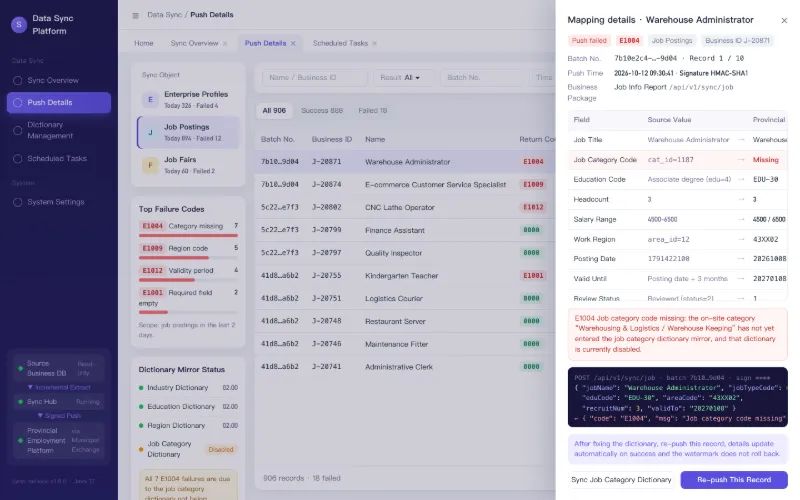
API errors stayed in server logs — ops had no idea which employer or job failed to report.
The legacy site couldn’t change, yet the province needed standardized, timely, auditable data.
Shanku built a standalone sync middle layer that sits beside the legacy site, reading its database without altering any front-end or review workflow. It handles incremental extraction, field mapping, batched delivery and per-record logging, so ops can see in the admin console how far each dataset has synced, which records failed and why.
Read-only, side-by-side
The sync service reads the legacy MySQL database cross-schema; all data entry and review stay on the original site.
Watermark-based sync
Employers, jobs and job fairs each keep their own high-water mark; only newer changes are pulled, in time order.
Mapping in SQL
Dictionary joins convert categories, education and districts to provincial codes; dates become YYYYMMDD, addresses are trimmed.
Business rules upfront
Four employer verification states map to the province’s valid/invalid; only jobs within three months of posting are sent.
Batched, logged per record
Records go out 10 per batch, each batch with its own ID; every result code is logged and the watermark advances per record.
Dictionaries first
Industry, education and region dictionaries are mirrored in full; each dataset runs on its own schedule or on demand.
Watermark-based incremental sync
Read mark
Load the last synced timestamp
Extract
Query changes past the watermark
Map & clean
Apply provincial codes and formats
Batch
10 records per batch, unique batch ID
Sign & send
Signed call via the city exchange hub
Log
Store result code per record
Advance
Move the watermark, fetch next batch
The watermark advances after every record, so an interrupted run resumes from the last success without re-sending anything.
Zero legacy changes
The recruitment site and its review flow stay as-is; business tables only maintain a change timestamp.
Every record traceable
Each push carries a batch ID, record ID, result code and message — “was it sent, why did it fail” is one search away.
Resumable runs
Per-dataset watermarks advance record by record, so interrupted jobs resume instead of re-pushing everything.
Tunable by config
Batch size and schedules are configurable, test and production credentials are separate; rate-limit changes need no SQL edits.
Screens are prototypes or rebuilt with sample data. They contain no real client data, amounts or accounts.
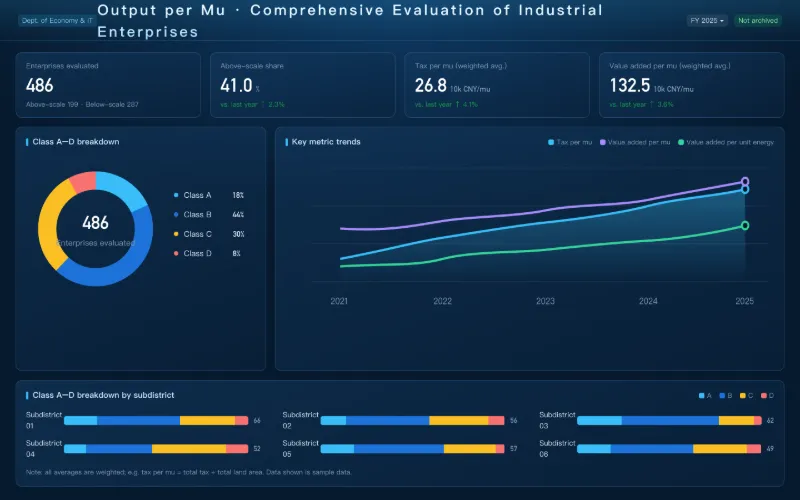
Wenzhou Municipal Bureau of Economy and Information Technology
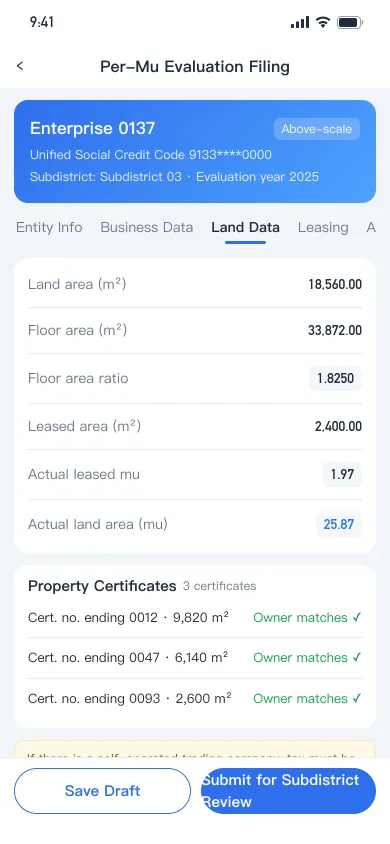
Grades hundreds of industrial firms on output per unit of land: roster import, online filing, six-department review and automatic A–D grading, fully audited.
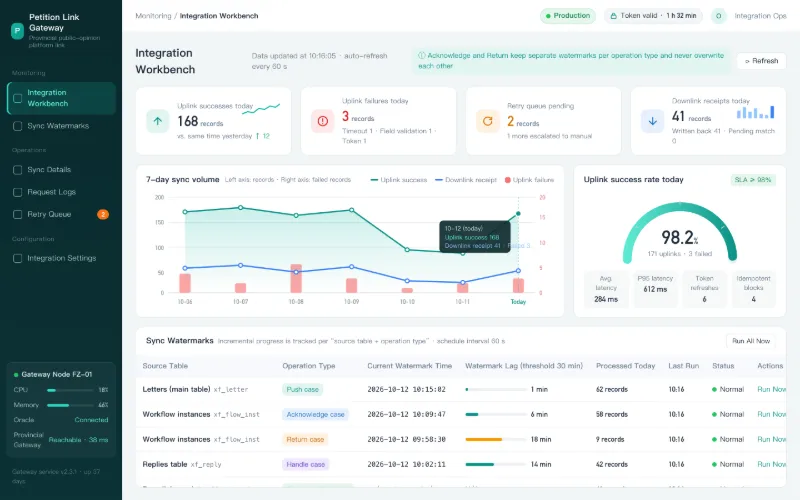
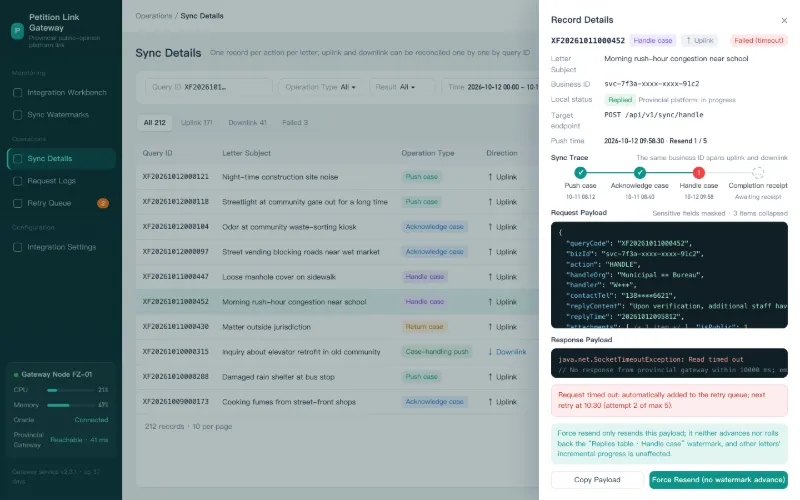
A single intranet gateway with a closed two-way loop for push, receipt, return and completion notices.
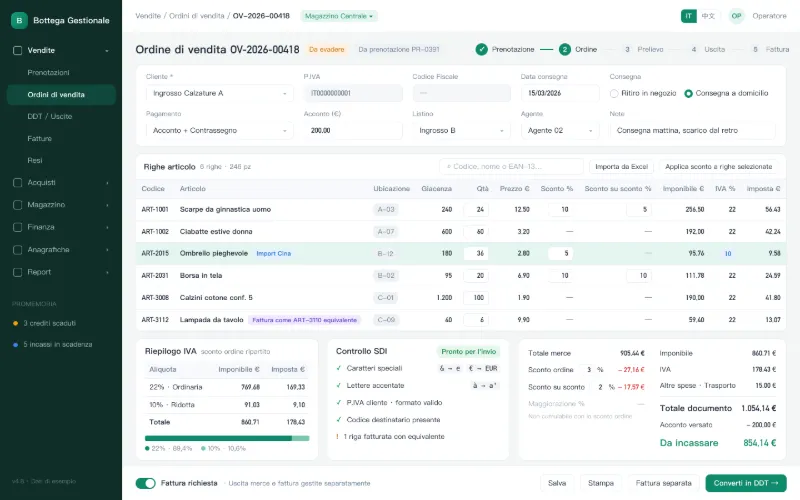
Chinese-owned supermarket group, Italy
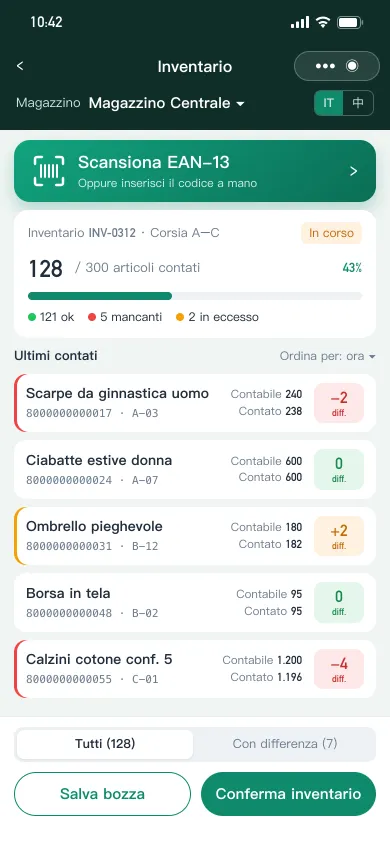
Italian VAT, e-invoicing compliance, stacked discounts, multiple languages and integrated POS, serving hundreds of wholesale buyers and thousands of retail stores.
See how we work together: from requirements and prototypes to launch and handover, every step is spelled out in advance.