1Scattered lists
Statistics, market regulation and tax each kept a list; sub-district surveys added duplicates and gaps.

Government
Grades hundreds of industrial firms on output per unit of land: roster import, online filing, six-department review and automatic A–D grading, fully audited.
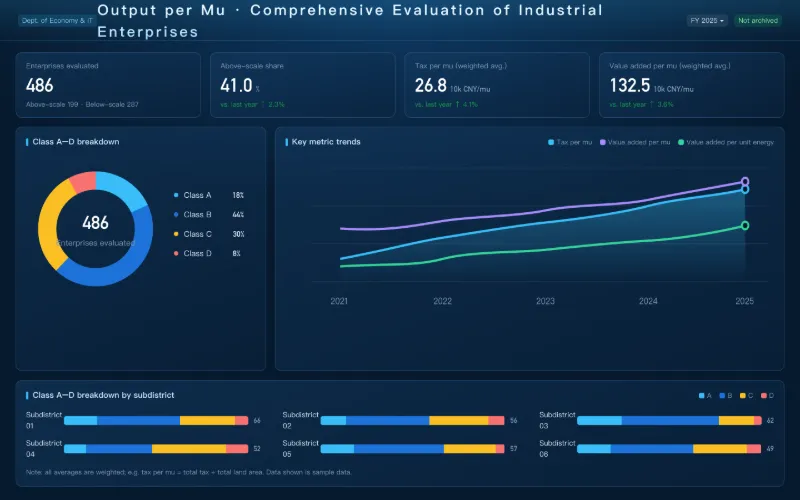
Each year the Wenzhou Municipal Bureau of Economy and Information Technology runs a Per-Mu Efficiency Evaluation of several hundred industrial enterprises. (A mu is a Chinese land unit of about 667 m²; firms are graded on tax revenue, value added and similar output per unit of land.) The grades guide land allocation, policy support and risk monitoring. Company lists came from several agencies, firms reported offline, departments reviewed in separate spreadsheets and scoring was done by hand; the bureau needed one traceable online pipeline from list to final grade.
1Scattered lists
Statistics, market regulation and tax each kept a list; sub-district surveys added duplicates and gaps.
2One reporting channel
Firms could only submit on PC or offline, so smaller firms rarely took part.
3Siloed reviews
Tax, land, power and environment data moved in separate spreadsheets with inconsistent definitions.
4Opaque grading
Weighted indicators plus bonuses, penalties, upgrades and vetoes were error-prone and hard to explain.
Scoring was never the hard part: sourcing the list, coordinating reviews and explaining results were.
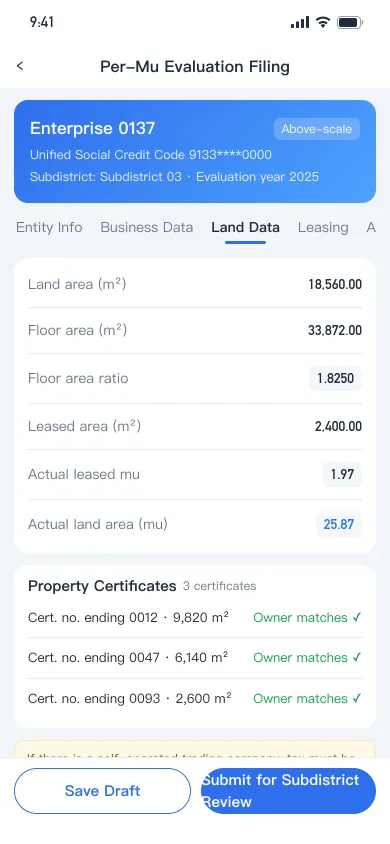
Shanku built an evaluation platform where the PC console, the Zheliban app for enterprises and the Zhezhengding app for officials share one backend. Weights, industry benchmarks and adjustment rules live in parameter tables, so annual changes rarely need code.
De-duplicated roster
Agency lists are merged and de-duplicated; sub-districts confirm size and sector, upload exemption proof and transfer firms between districts.
Online filing via Zheliban
Firms sign in with their unified social credit code; actual land use, plot ratio, power use and tax contribution are derived on save.
Six-department review
Tax, land, planning, power, statistics and environment each review their own data or bulk-import Excel; approval triggers a recalculation.
Automatic scoring
Indicators are scored against industry benchmarks and weights; separate A–D cut-offs for larger and smaller firms; batch runs and rollback.
Codified adjustments
Bonuses capped at 20 points, penalties at 40; upgrades, holds, downgrades and vetoes run in a fixed order with no grade skipping.
Yearly isolation & audit
Data is partitioned by evaluation year and read-only once archived; logs record operator, action, firm and channel.
Evaluation pipeline
Import roster
Merge agency lists into one register
District survey
Confirm size, sector and eligibility
Firm filing
File on Zheliban; derived fields auto-filled
Joint review
Six departments review; approval recalculates
Score & grade
Weighted scoring, A–D cut-offs
Adjust
Bonuses, penalties, upgrades, vetoes in order
Report & archive
Word report export, year archived
A firm enters the scoring queue only after its sub-district and every department have approved; each score and adjustment carries a written rationale for firms and auditors.
One traceable pipeline
Every step from roster to final grade records status, operator and notes, replacing spreadsheet reconciliation.
Explainable results
Each firm’s indicator values, item scores, adjustments and grading reasons are written out and ready to share.
Configurable rules
Weights, benchmarks, grade ratios and adjustment rules are maintained as parameters, not code.
Mobile coverage
Firms file from their phones on Zheliban; officials work on Zhezhengding with the same permissions as on PC.
Screens are prototypes or rebuilt with sample data. They contain no real client data, amounts or accounts.
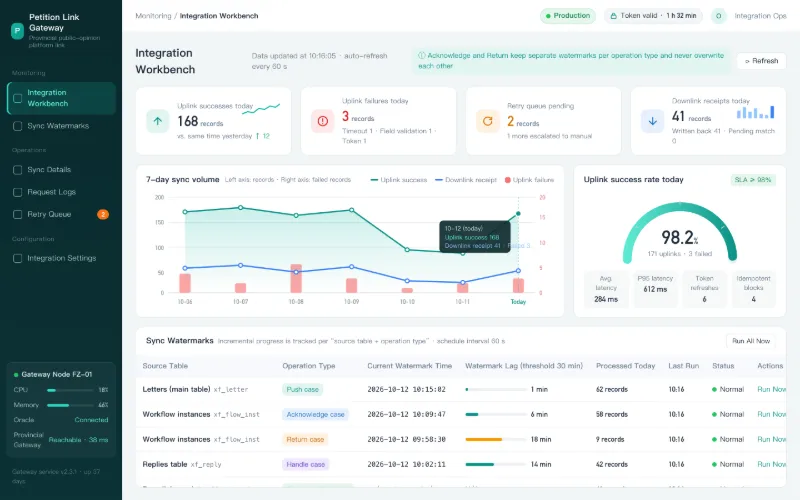
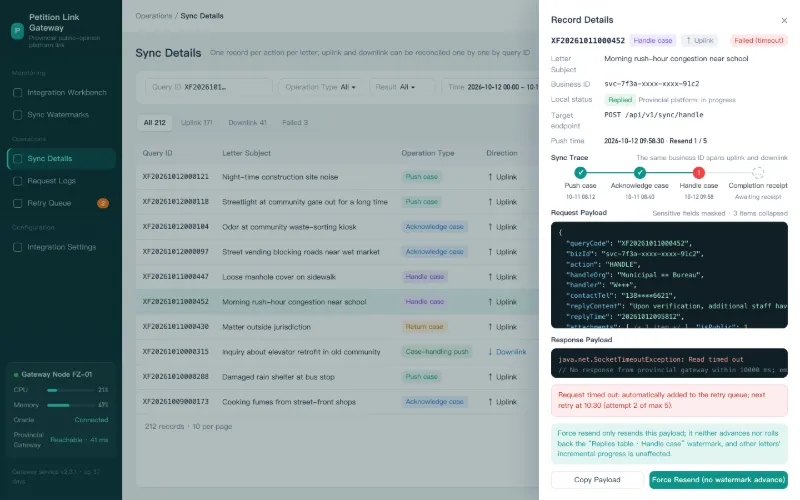
A single intranet gateway with a closed two-way loop for push, receipt, return and completion notices.
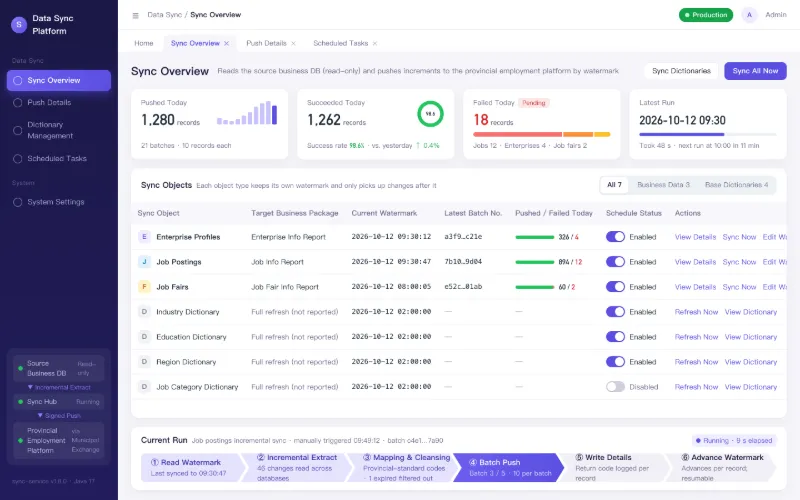
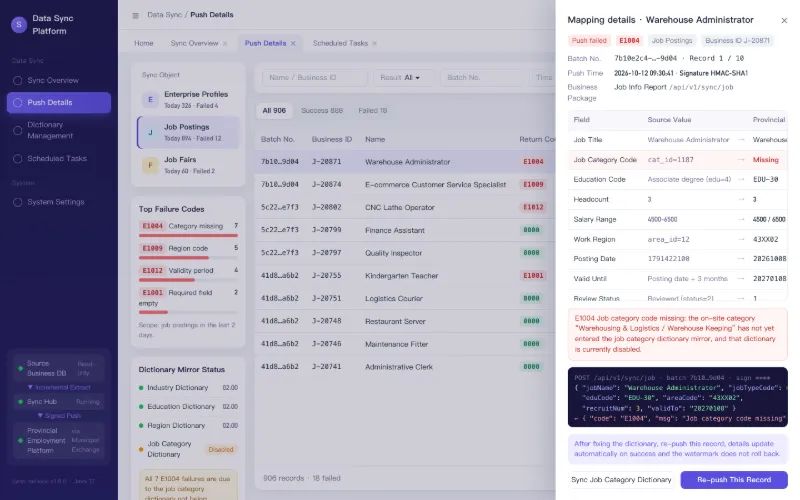
A side-car sync hub that pushes increments by watermark without touching the original site; failures are searchable and resumable.
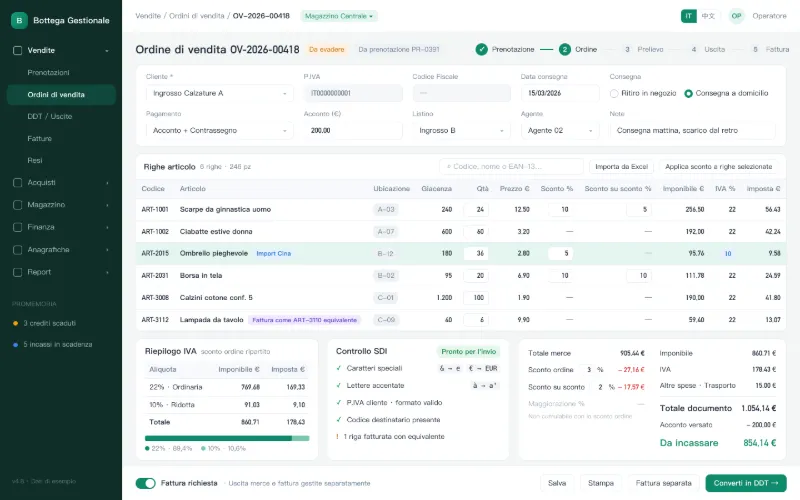
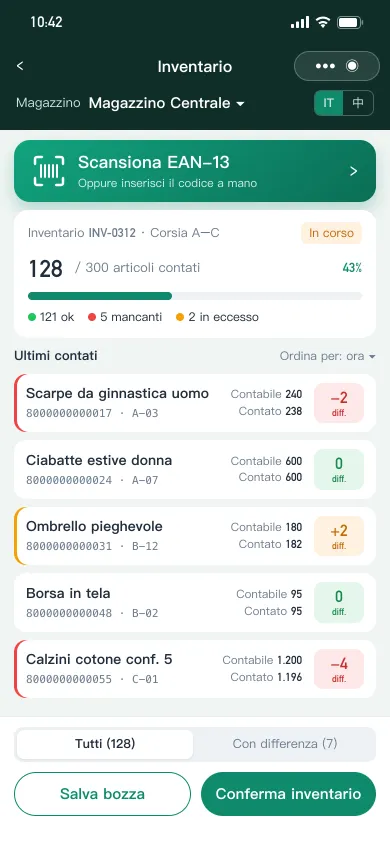
Chinese-owned supermarket group, Italy
Italian VAT, e-invoicing compliance, stacked discounts, multiple languages and integrated POS, serving hundreds of wholesale buyers and thousands of retail stores.
See how we work together: from requirements and prototypes to launch and handover, every step is spelled out in advance.