1Mismatched status models
Five local handling stages did not map cleanly to the four provincial actions: submit, accept, return, and resolve.

Government
A single intranet gateway with a closed two-way loop for push, receipt, return and completion notices.
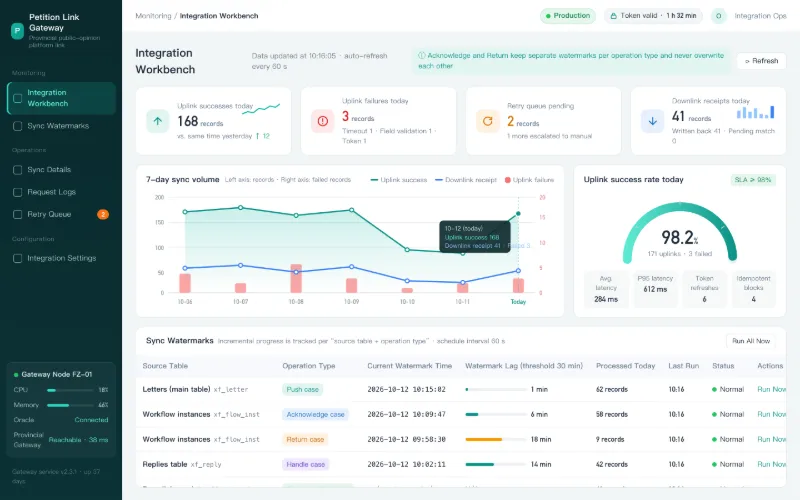
A city-level online petition platform had run for years, with every citizen letter, referral, reply, and closure stored in an Oracle database. Once the provincial public-opinion platform was rolled out, local letters had to flow both ways with it under the provincial API specification. The core mailbox system could not be changed, so an auditable integration channel had to be built alongside it.
1Mismatched status models
Five local handling stages did not map cleanly to the four provincial actions: submit, accept, return, and resolve.
2Scattered sources
Letters, accept/return actions, and formal replies lived in three tables, so a shared sync timestamp kept overwriting itself.
3Untouchable core
The mailbox workflow was stable; embedding integration code risked live operations and made acceptance testing harder.
4Silent failures
Failed script pushes were buried in logs, and case handlers could not tell which letters never reached the province.
Close the loop with the provincial platform without touching the live mailbox core.
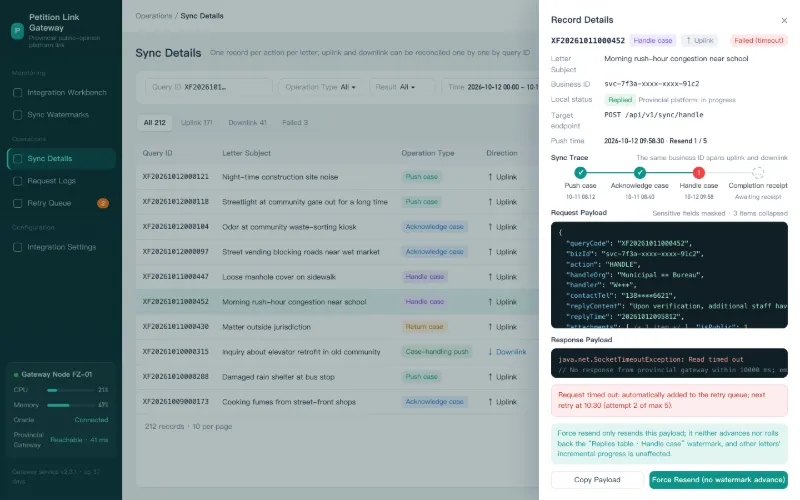
Shanku deployed a standalone integration service on an intranet gateway server as the only path to the provincial platform; the mailbox system never calls provincial APIs directly. The service handles incremental extraction, field mapping, authenticated calls, and write-back, with a PC operations console that shows the sync status of every letter.
Single gateway exit
The integration service runs on its own intranet gateway, isolated from the mailbox and able to start, stop, and ship independently.
Four upstream actions
New letters, acceptances, returns, and final replies are converted to the provincial format and pushed one by one.
Downstream write-back
Provincial closure receipts are matched by business ID and written back as status, reply, and routing records.
Per-action checkpoints
Sync checkpoints are kept per table and action type, so accepts and returns never collide and runs resume after interruption.
Idempotency and retries
The same business ID and action is never pushed twice; network failures go to a retry queue and escalate to staff after the limit.
Visible, re-pushable
The console shows checkpoints, sync records, and request logs, and can force a re-push by tracking number without disturbing progress.
Two-way letter loop
Extract
Read changes from Oracle by action type
Map
Build provincial payloads; defaults from config
Push
Sign, obtain a token, and call the provincial API
Record
Store the response; failures go to retry
Receive
Province pushes the closure receipt
Write back
Update status, add reply and routing records
Each letter keeps one business ID from first push to closure, so upstream and downstream records reconcile line by line.
Compliant, uninterrupted
Meets the provincial platform’s unified access and data aggregation requirements without rebuilding the mailbox workflow.
Reconcilable status
One business ID runs from push to closure, so the full upstream and downstream history of any letter is traceable.
Accountable operations
Sync records, request logs, and a retry queue replace digging through server logs; logs are kept for at least 180 days.
Reusable pattern
The sidecar gateway plus checkpoint-and-record approach carries over to other provincial data exchanges.
Screens are prototypes or rebuilt with sample data. They contain no real client data, amounts or accounts.
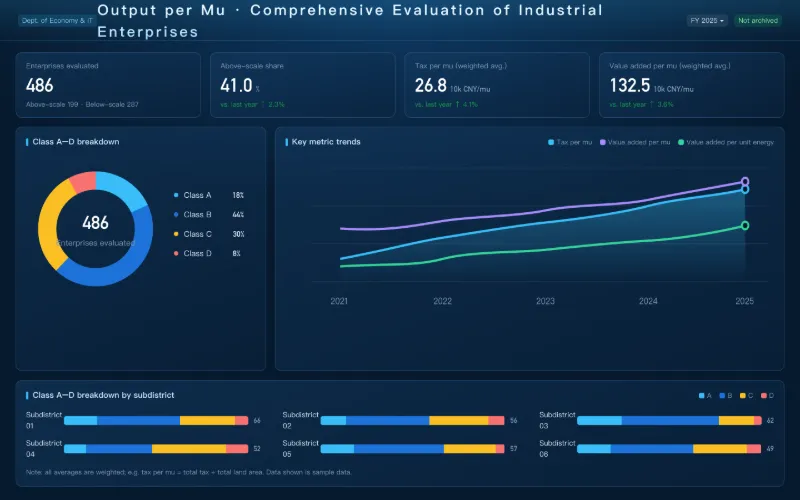
Wenzhou Municipal Bureau of Economy and Information Technology
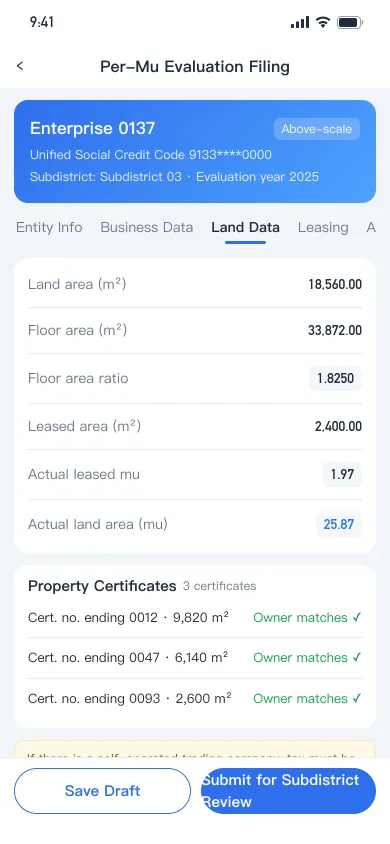
Grades hundreds of industrial firms on output per unit of land: roster import, online filing, six-department review and automatic A–D grading, fully audited.
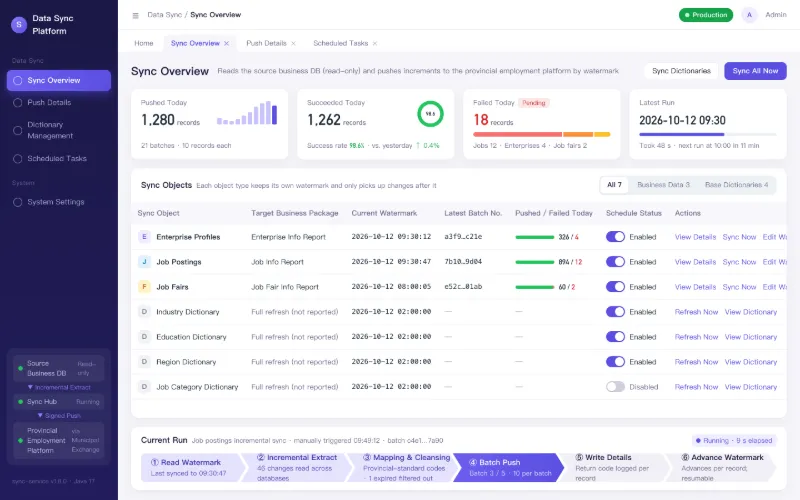
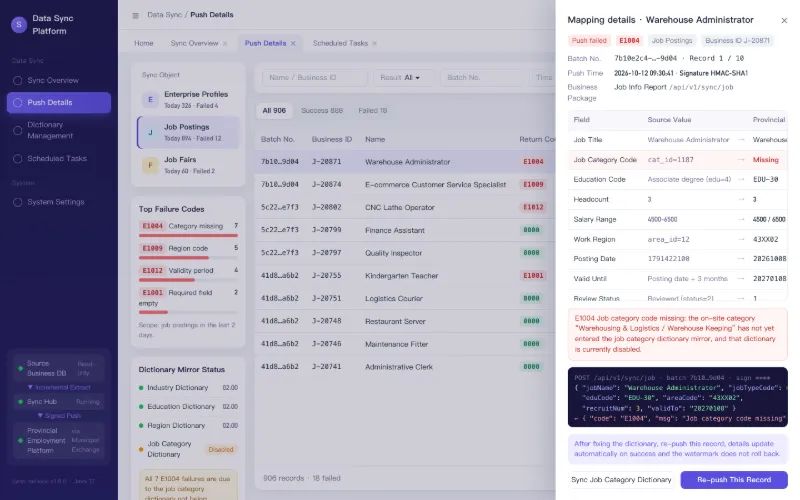
A side-car sync hub that pushes increments by watermark without touching the original site; failures are searchable and resumable.
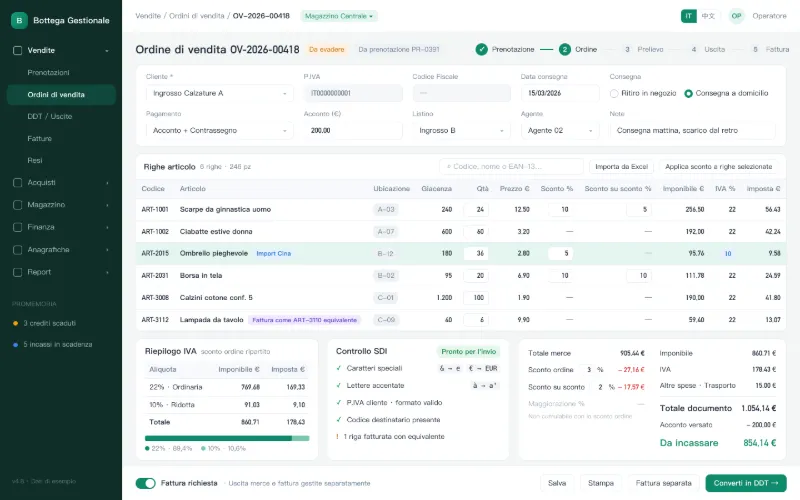
Chinese-owned supermarket group, Italy
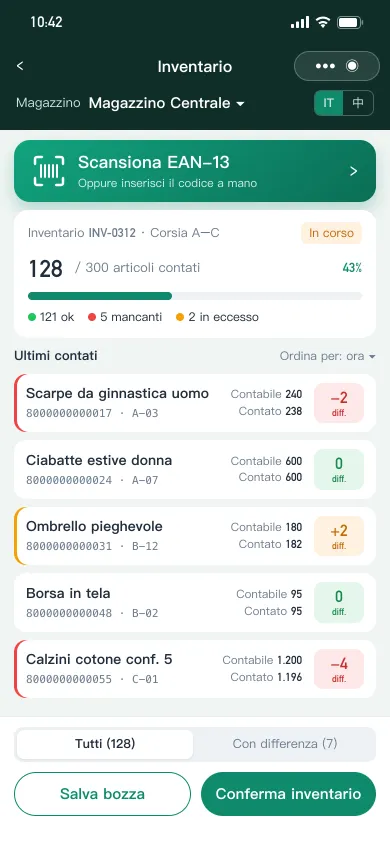
Italian VAT, e-invoicing compliance, stacked discounts, multiple languages and integrated POS, serving hundreds of wholesale buyers and thousands of retail stores.
See how we work together: from requirements and prototypes to launch and handover, every step is spelled out in advance.